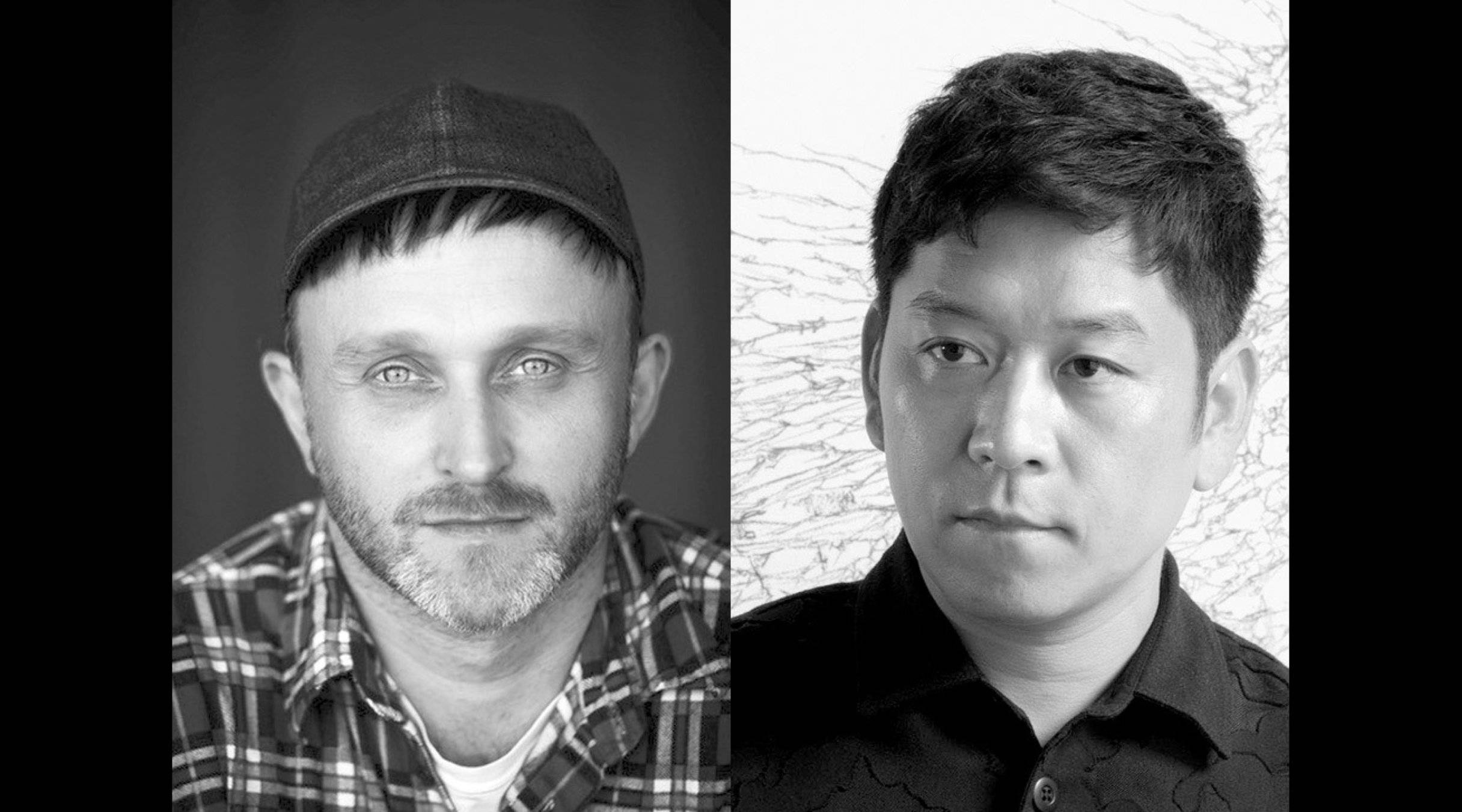
Your collaboration began in 2014, now more than ten years ago. How did you first meet back then?
DAMIEN JALET I discovered Kohei’s work in 2013, when I was attending a performance at the Setouchi Triennale in Japan. Ten minutes before closing time, I went to the top floor, and there I saw his installation Foam: a cloud of soap foam that reminded me of a rock formation, or of black sand dunes. It was a work that truly absorbed me: as you walked through it, it completely changed form. I felt as if I were being taken into something very organic.
KOHEI NAWA Yes, and you could also say: what connects us is not only our work, but also Japan.
You have already created three striking productions together: VESSEL (2014), Mist (2020) and Planet[wanderer] (2021). With Mirage, you are making your first piece specifically for the Ballet du Grand Théâtre Genève. Is there a connection between all these works?
KN I do think all four are intrinsically connected. To explain that, I’ll start with the preparatory work for Planet[wanderer], because the central element of this piece emerged from there as well. During that preparation, we reflected on our way of life and our relationship to the world. In 2020, everyone was isolated and confined due to the pandemic, and yet the world kept turning. It was a difficult period, and I wondered what drove people to keep going anyway. Damien and I talked about this, and we realised that some form of hope seemed to keep people moving forward. If you imagine the world as a desert, then people keep walking because there is something in the distance, a kind of mirage—that’s how I picture it. They hope for the next stage, whether that mirage truly exists or not.
DJ Indeed, many elements build on what we developed for Planet[wanderer], particularly that idea of wandering. In the first part of that piece, the dancers were presented as rocks, or as plants rooted in a shifting ground. Only in the second part did the human appear, when the dancers began to walk. In Mirage, that process is reversed: we begin with the human. The dancers are dressed and wander as if lost in a desert, completely dehydrated—both physically and mentally. What drives them is that hope somewhere in the distance. Kohei has designed a space in which this idea is reinforced by placing the horizon at the centre. For me, it is a metaphor for the future: a mirage that makes you doubt what you see.
The scenography is a real physical challenge. How does it affect the dancers’ work?
KN The scenography is conceived as a large wave across which the dancers constantly move. This shifts their centre of gravity, making it difficult for them to stay upright—the slope of the floor is that steep. On top of that, there is mist, water droplets, and sequins falling from above that cover the dancers.
DJ The scenography certainly puts the dancers to the test. Everything is built around the relationship between the dancer and their centre of gravity. We already explored this with the Ballet du Grand Théâtre in Skid (2022), but now the angle of the slope keeps changing, and the dancers must constantly move between a horizontal and an almost vertical surface. I find it fascinating that humans must continuously adapt to their environment, and I believe we should actually always do that, rather than forcing the environment to adapt to us.
The dancers wander through a desert. Why choose such an environment?
DJ The desert is an interesting theme that recurs regularly in our work, but especially in Mirage. It is also linked to the image of the oasis: that small island where water exists and where plants can grow. If you look at the Earth from space, you see that the most densely populated areas are always near water, and everywhere humans have adapted to their environment. But there are exceptions—Dubai, for example, where the environment has been transformed to build a city that itself resembles a mirage. I also like the idea that Earth itself is an oasis in the desert of space. For this piece, we were therefore inspired by two environments: the sand dune and the ocean. This creates a dialogue between a colourless, dry space and the moment when a colourful rain begins to fall.
Water also keeps returning.
DJ That’s correct. Water is an essential element in our work. VESSEL had a water floor, in Mist we used water in vapour form, and Planet[wanderer] was a completely dry environment with something like energy wells. In Mirage, you are in a world where humanity seems to have disrupted the water cycle. I also find it interesting that water is almost a divine element: in science it represents the origin of life, while in some mythologies it symbolises death.
What meaning does the emergence of colour have in this piece?
KN In the second part, after the journey, a kind of rain of coloured sequins falls from the sky, covering the dancers’ bodies and triggering a transformation or metamorphosis. These colours do not simply fall from the sky. I chose them as a metaphor for planets. We live on Earth, but there are other possibilities: somewhere, another world exists. The bodies adorn themselves, as it were, with these different possibilities.
DJ When I first saw the dancers with their colour-transformed skin, I thought of certain insects. There you also often see an incredible combination of warm and cold colours, with shimmering effects that reflect light to varying degrees. What fascinates me about insects is their capacity for rapid and radical metamorphosis. Think of a butterfly: it first lives for a long time in the ground, only to fly briefly after a kind of rebirth. That is also what we did in VESSEL: bodies twisted into each other and suddenly formed a new kind of organism. Humanity tends to see itself as unchanging, but our society is constantly evolving. This inevitably has a major impact on our way of life and also on our bodies. In Mirage, this transformation takes place through the arrival of water falling over the desert, allowing plants and colours to emerge, like in a tropical rainforest. Perhaps we should not see the world as something we must control, but as an element we are part of. We are living in a rather insane time, constantly in motion, with countless social codes and different ways of being and existing—and therefore also of metamorphosis.
Your work seems to reflect an optimistic view of the world.
DJ It always contains both. There is never stillness, and never an ending. Planet[wanderer] seemed quite apocalyptic, but even there it was not about death as such. It was more about a state of transformation, and that always contains a certain hope. It is like The Wizard of Oz: it begins in a very realistic, monochrome world, and then you enter another reality that is vividly colourful. You start to wonder which reality is real and which is a dream. In Mirage, we play with these shifting realities and with what seems unreal. Like in a dream, the piece contains many unpredictable factors and contradictory energies. In fact, depending on who you are and what you have experienced, the performance can evoke hope or the opposite. As a creator, I cannot determine whether it is optimistic or pessimistic. That is precisely the range we do not control and leave open to the audience’s interpretation. But I do believe the piece has something very peaceful about it.
How is that translated into choreography?
DJ This work is the result of highly varied research, and it contains many different scenes. Some moments are extremely fast, physical and intense; others are very calm and almost meditative, yet still carry a strong underlying tension. This requires the dancers to remain connected without necessarily relying on eye contact. In Mirage, we also introduce elements that influence the way movement unfolds. Among our four productions, this one probably has the most “chapters”, with a major division between the first and second parts, each with its own aesthetic and choreographic language. In the first part, everything is mathematical and precise, with hardly any physical contact between the dancers, while in the second part everything becomes more intimate and sensual, with more closeness and intuition.
How do you make these mirages and fata morgana effects visible?
KN By playing with light, colour and rain. We looked for a way to make the rain fall in a controlled manner, and ended up with a system that sprays water droplets spiralling around the dancers. Combined with the light, it creates the illusion that the spiral is rising into the sky. It is a beautiful moment, because the pigments seem to detach from the dancers’ bodies and evaporate.
DJ It is indeed an impressive scene, and a good example of an optical illusion that seems to defy the laws of nature and completely overturns your perception. We play with how to deceive the eye, and this illusion is an invitation to question the way we see and understand the world. What we think we see is not necessarily what is there. In a sense, our society is built on purely visual features and superficial perspectives—such as hierarchies based solely on skin colour. Today, new illusions are constantly emerging, driven by artificial intelligence, virtual reality and the creation of avatars. All these digital elements offer a fundamentally numerical alternative to life, whereas what we present in our performances is deeply physical and real. What interests us is this interplay between what is real and what is not.
KN Exactly. And to return briefly to technology: there is a scene—just before the one with the sequins—called “Ghost”. I projected video onto the rain, making it seem as if you see holograms of the dancers’ bodies instead of the dancers themselves. They become ghost-like versions of themselves, losing their physical weight.
DJ They become digital bodies. We often work with this idea of disembodiment and re-embodiment: leaving the body and returning to it. It is almost an atmospheric phenomenon reminiscent of mirages—and fata morgana. What is fascinating is that you think you are seeing an illusion, but one that can actually be captured in reality, photographed or even filmed. We all have an image of a fata morgana, like a ship floating above the horizon. This phenomenon arises from atmospheric changes and the way light is refracted. That is why we pay so much attention to how to create that effect.
KN Yes, at the beginning we use a special lamp with a certain frequency that removes colour and immerses the space in a monochrome world, which is later revealed again.
How much room is there in your creative process for experimentation?
DJ I’d like to talk about that, because my work is largely based on experimentation, and in Geneva we are presenting something I have never done before. We first made a sketch: Mirage[transitory], an intimate first version performed in Fukuoka in a theatre with about a hundred seats. That version allowed us to try things out during rehearsals, something you cannot do when time is limited. During that experimental phase, Kohei suggested using clay, a material often found in mythology and also very important in Japan. It was August, I remember. It was nearly 40 degrees, and we completely immersed the dancers in it. Then they had to walk, and we noticed the water evaporated and the clay dried quickly, forcing the dancers to move more slowly. In the end, we decided not to use clay, because it would not behave the same way in the Grand Théâtre. But it did influence the choreography. The performance we are showing in Geneva would not exist without that experimental phase.
Finally, about the music: how was your collaboration with Thomas Bangalter?
KN Thomas is truly incredible. His music has exactly the right energy for this piece. As a composer, he is very powerful and creative. He quickly understood what this work is about, and he does not hide his enthusiasm.
DJ We first worked with him on Chiroptera (2023), and from the start I found him absolutely amazing, with that impressive creative energy and perfect command of his craft. I love creating connections between different artistic disciplines, and I knew we shared an interest and love for Japan—just like Kohei. Our working methods are also quite similar. He was also present in Fukuoka, where he could experiment while watching us work. For Mirage, he found a musical idiom that is not overly melodic, yet still offers anchors for choreography. We therefore depart from how we worked on VESSEL. Here in Mirage, the music is very specific and evolves with the scenes. In the first part, you hear something quite rhythmic that gives the dancers a structure to hold onto. In the second part, it becomes completely different. You could say Thomas is a sound sculptor: he draws his music. Working with him on Mirage felt natural, as if something had brought us together. We like to think differently about things than is usually done.