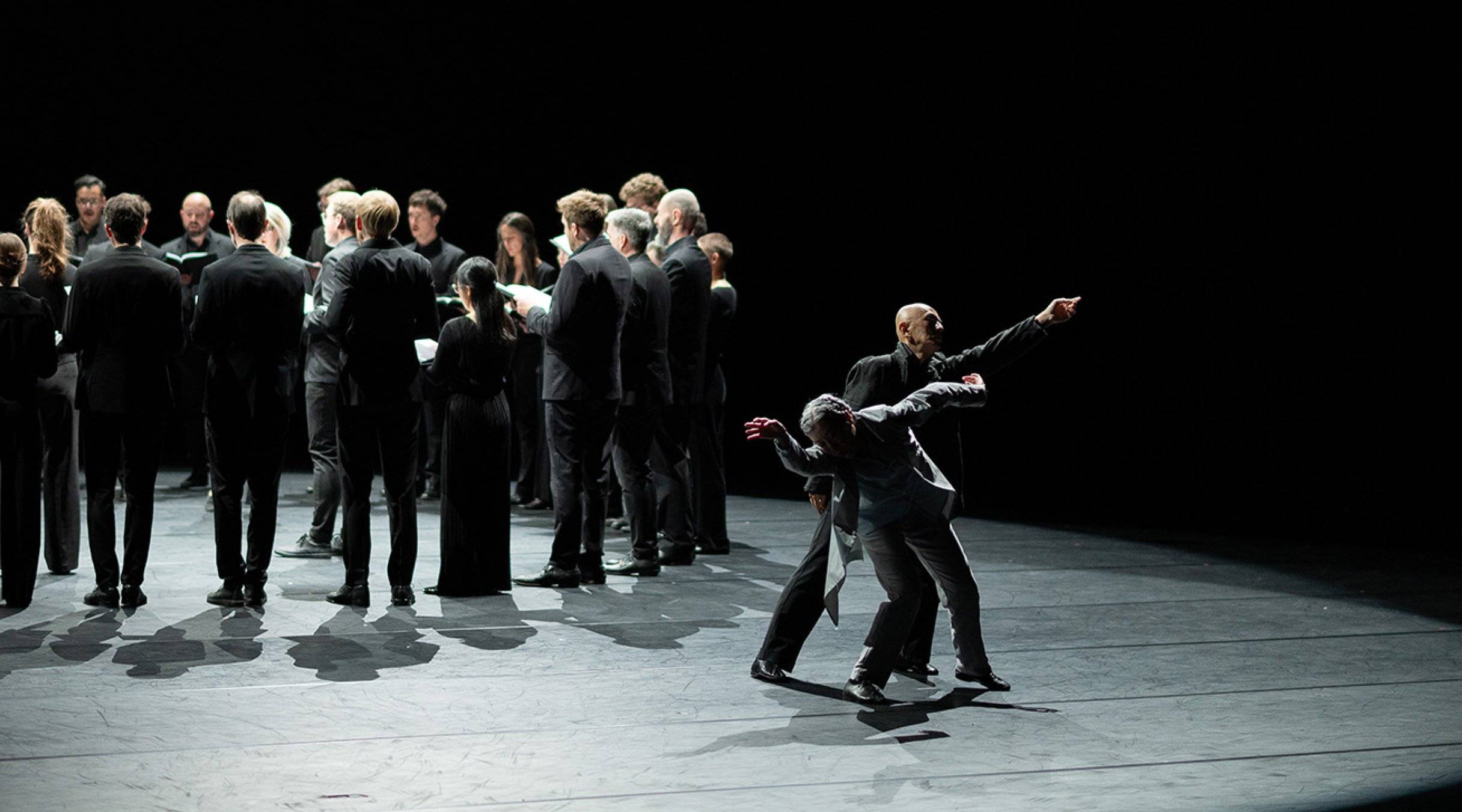
Lionel Meunier (conductor and artistic director of Vox Luminis) is fascinated by timbre and vocal placement; few possess his gift for finding exactly the right voice for the right score. Saburo Teshigawara (dancer and choreographer) has been captivating audiences for decades with abstract choreographies in which dancers forge a unique relationship with music and space. In Spem in Alium the two artists are collaborating for the first time on five works from the English sacred choral repertoire. At the heart of the programme is Thomas Tallis’s magnificent sixteenth-century polyphonic motet Spem in Alium. For this occasion, Vox Luminis expands into an XL choir of forty voices. Teshigawara, now 72, directs, choreographs, designs the lighting and costumes, and also performs on stage alongside three other dancers.
How easy was it for you to agree to this collaboration?
LM: When the Paris Philharmonie approached me about this project with Saburo, I immediately said yes, because I like being guided by curiosity. Of course, Bach’s Mass in B minor continues to challenge and move me every time. But its structure is familiar, the path known. In this collaboration with Saburo, I have far less control over how things will unfold. Forty singers, four dancers, a choreographer who thinks through the body—it forces me to stay alert.
ST: For me, it is very exciting to share, in a physical way, through the bodies of dancers and choir members and through their voices, the long history and depth of this music with the audience. When I worked with the Paris Philharmonie in 2011 on Bach and Bartók, I already expressed my wish to work with purely vocal music. The only difficulty with Spem in Alium was that the musical selection had already been made. But I empty myself, I open myself. The contact with Lionel gives me confidence.
In what way was it difficult that the musical selection had already been made?
ST: This music is not simple. When I make my own decisions, I can imagine anything, or simply set things aside. But here the work was already done, the music is there—even if I do not know the score, cannot read the musical notes, and know little about its history: it exists as a reality across time and cultural difference. In that sense, it becomes an encounter with a particular force. But “difficult” is a challenge, an opportunity to try, to transform something. As Lionel says: it creates curiosity. In short, for me there is little difference between joy and difficulty. I simply like anything that is difficult (laughs).
LM: What also plays a role is that Spem in Alium, the motet by Thomas Tallis around which the evening is built, is one of the most iconic vocal works in music history: forty voices, each with its own part. It begins with a five-voice polyphony, builds up to forty, and returns again to five voices. Interestingly, scientific studies have shown that the human brain cannot process 40 separate vocal lines. Apparently, you can only distinguish about 30, at most 32, and which ones you hear differs from person to person. That is what makes me so curious: what will Saburo do with this?
What does the title Spem in Alium / “Hope in Another” evoke for you?
LM: I keep returning to the first word: Spem—hope. For me, there is a personal story attached that Saburo does not yet know. When I first sang Spem in Alium in 2002 in Minneapolis Cathedral, with the choir surrounding an audience of 3,000 people, I was so overwhelmed that afterwards I could not speak for a while. It was there and then that I understood I would make singing my profession. Precisely because the work had such a life-changing meaning for me, I wanted it to be central in this project. A detail: my mother didn’t really like this music, but this time she is came because she wanted to see Saburo and his dancers (laughs).
ST: Lionel explained to me that spem in the text is connected to God—that alone I find interesting. In Japan there is not one god, but uncountable nature deities, and a higher force is present in humans and matter. I do not want to ignore that difference. In addition, the final line of the motet stayed with me: “Be mindful of our humility.” Those words brought me to powerlessness, foolish human powerlessness. How do we differ from animals, robots, objects? I want to take that as a starting point for the dance. I am often frightened by the darker sides of humans. I try to be a good person myself—which is often difficult. But ultimately it is not about good or evil; what matters is being able to see without judgment: you are you, and sometimes I want to be you, or myself, or a shaman. Spem in Alium is music that has the power and beauty to measure those kinds of questions, like a journey through what it means to be human. That is my approach: to arrive there through this music.
How important is the sacred dimension of this music for you?
LM: For me, it is inevitable to take it into account. When we sing Renaissance music with Vox Luminis, we always feel deeply connected. Whether that is due to the text or something spiritual is unclear. For me, it is precisely the mystery that creates the beauty of this music. You do not have to be religious, but if you do not fully immerse yourself in what you are singing, something is lost. Sometimes it is about reminding the singers, amid all the technical aspects, what the music is about. That attention adds something to the timbre of the voice. When we rehearse in a church or cathedral, I always leave the door open so passers-by can listen. When I ask them about their experience afterwards, they say: I sit down, close my eyes, I pray, I think of people who are important to me.
ST: The sacred in these musical texts goes beyond the human for me. But before it exceeds us, it is also a physical reality. The body is not an independent object in its environment. The body breathes, sweats, exists in relation to water, rain, air and space. Without these elements that are given to us from above, we cannot live. Our body includes nature; the body itself is a nature space, and in that sense a sanctuary, without needing to be named as such—that is the kind of sacrality I think about. For me, the sacred is not about stories. I do not need a shared spiritual space. I pray without words; the feeling of connection is enough.
How do you work with that connection on stage?
ST: For me as a dancer and choreographer, everything begins with physical existence. There is gravity, the earth, and the weight of the body. Without a floor, you fall endlessly. We cannot fly, but we can jump and land. We can learn to fall and thereby experience the space between up and down differently. Gods may determine fate, but life is also a dance. Humans never stop moving: because we walk upright, we constantly make micro-adjustments to keep our balance. Dance is often about techniques to control imbalance. My idea is that natural timing is lost when you over-program the body’s memory of movement. My method is to return, through conscious breathing, to a natural open state, and from there to start with —not so much improvisation, but what I prefer to call a “spontaneous reorganisation” of the body. Emptying, opening, merging: that is how we will relate to the music.
LM: The presence of dancers will affect the timbre of the choir. The same applies to the audience. That is natural: when you feel a connection, it subtly changes the voice. We cannot capture this phenomenon with software or language, but people will sense it. That is the magic. In that respect, something similar to what Saburo calls “spontaneous reorganisation” will also happen in the singers.
ST: The body continuously rearranges itself in relation to sound, proximity, and space. Sometimes we do nothing. That doing-nothing is essential. Like rain that stops but leaves the body wet. From there, something can emerge.
The five works in the programme of Spem in Alium feature slow vocal lines written for large ceremonial spaces. How do you view this in relation to this project?
LM: We once collaborated with dancers in an opera by Charpentier with Vox Luminis, where we also danced —or at least attempted to (laughs). In opera, acting and dance are part of the framework, but sacred music is a different category which I am much more careful with. Renaissance polyphony carries a ritual within it. People sense that immediately, even without understanding the words. A shared attention arises that is difficult to name. One thing I greatly value in sacred music is spatiality. I know Saburo also works with that, which makes this collaboration interesting. I also see the slowness of Renaissance music as an opportunity to relate to time differently—away from the speed we impose on ourselves outside the concert hall.
ST: Rhythm is not essential to dance. Because Spem in Alium is so non-rhythmic, it offers a unique opportunity to share breathing rhythms and cycles. Breath is fundamental, whether you are a dancer, singer, or listener. From the dancer’s perspective, you can feel the choir’s breath. Breathing is also a way for dancers to share their own musicality with the singers. By directing breath consciously through different parts of the body—spirals, curves, etc.—they can create counterpoints to the music.
LM: It is fascinating how close dance and music are: both use the body and breath as instruments. The human voice is extraordinary—the mystery of those two small vibrating membranes of barely 2 cm in our throat. In Renaissance music like Spem in Alium, we sing long lines, so we must become much more aware of how our breathing can sustain them without stopping the flow at the wrong moment.
If you could give the singers a workshop in your KARAS studio in Tokyo, what would you propose?
ST: Well, I am planning to hold a small workshop in Bruges the week before the performance, when the full choir is present. I want the singers to pause before they move. To feel gravity through the soles of their feet, to breathe together with the dancers, to inhale the space through their palms, to feel how that sensation travels along the spine as a living structure with bolts and fluid that can expand and release. How it opens the antennae of our awareness. I want to share that “real” feeling, beyond prescribed movement. For me, that is inaudible music. That is why, for us dancers, the voices of singers are fantastic: you can watch their progression, their responses—you can see by listening, and listen by watching. Finding harmony between the dancers’ breath and the singers’ breath feels like a wonderful lesson to share.
How crucial is the spatial arrangement of the choir for an optimal listening experience? How do you discuss this?
LM: For me, it is essential that we can hear each other well enough to perform optimally as a choir. Saburo also knows that when a composer added written instructions to the score, I prefer to follow them. It is known that Thomas Tallis intended Spem in Alium for five groups of eight singers. The most common setup is an octagon—and that is what we will go for. In Funeral Sentences, Thomas Morley indicates that the first part should sound like a procession. So I would like us to walk in procession, while Saburo ensures that we do not march like a military parade (laughs). For the second and third parts, Morley wants the choir to stand around a coffin, and we will keep to that too. The other composers give no instructions. Before coming to the Concert Hall, we will already have worked deeply on the musical interpretation. In Bruges my only question will be: what do you have in store for us, Saburo? Again, I am very curious.
ST: I have several possible choir formations drawn out on paper: lines, circles, and squares in different constellations and proportions. That will keep me occupied for a while. And we remain in dialogue.
By Lieve Dierckx, interview 20 December 2025.