Press Release
Amsterdam, 28 June 2026
Holland Festival concludes with world-class performances and the next generation of artists
The 79th edition of Holland Festival came to a close with a final weekend full of theatre, music, opera, dance and a rave.
The weekend opened in Amsterdam with LACRIMA by Caroline Guiela Nguyen, a performance exploring the harsh realities behind the world of haute couture, and the exuberant Bilderschlachten. In Heerlen, the weekend started with A Possibility by Germaine Kruip. On Saturday, audiences at Rave-L, the radical reinterpretation of Ravel's Boléro, were invited to dance to the beats of DJ Parrish Smith. The festival concluded on Sunday with the final performances of Simon Boccanegra, the youth project JÖRĐ, and A Trial – after an Enemy of the People. The closing weekend reflected the festival as a whole, which this year centred on deep listening and genuine attention—from the overwhelming soundscape of Chernobyl in the Gashouder to the intimate reflections on grief in Sada (Echo).
Emily Ansenk, Director of Holland Festival:
'This year's associate artist, Hildur Guðnadóttir, invited audiences to listen – with empathy, attentiveness, curiosity, and space for nuance and for one another. From the opening event City of Floating Sounds by Huang Ruo, through Laurie Anderson's fitting interlude, to the closing concert Rave-L, this theme resonated throughout the festival. The programme ranged from large-scale productions to intimate performances, spanning disciplines, forms and styles, yet each invited audiences to engage through careful listening and attentive looking. Judging by the response, this struck a chord at a time marked by uncertainty, noise and vulnerability. Silence, attention and focus became valuable experiences. The festival fostered countless meaningful encounters, inspiring conversations and, above all, delighted artists.'
Hildur Guðnadóttir
Hildur Guðnadóttir presented no fewer than four new compositions, all commissioned or co-commissioned by Holland Festival. One of these, Passing Remark, was performed by more than forty brass players from various conservatoires in the sunlit Westerpark. For Nærmynd, Guðnadóttir combined her own work with one of the boldest compositions in contemporary music history: Alvin Lucier's Silver Streetcar for the Orchestra. Sam Slater performed this remarkable solo for triangle, revealing the instrument's extraordinary sonic richness.
Attentive listening was richly rewarded in Where To From, her concert for a seven-piece ensemble of strings and sopranos, featuring music from her new album and concluding with what Guðnadóttir considers Iceland's most beautiful song, Heyr Himnasmiður.
One of Guðnadóttir's greatest wishes was to meet the artist and composer Meredith Monk. That wish came true during the post-screening conversation following the documentary Monk in Pieces at Eye Filmmuseum. Although the two artists had never met before, they spoke as though they had been friends for years, completing each other's thoughts and sharing artistic perspectives in a warm and inspiring conversation. That same weekend, Monk gave a concert at BIMHUIS together with John Hollenbeck.
Forty singers and hundreds of toys: listening and looking with attention
Among the festival's highlights was Spem in Alium by Thomas Tallis. This Renaissance masterpiece for forty independent voices was performed by an expanded version of the Vox Luminis choir, accompanied by choreography by Saburo Teshigawara. And a selection of four centuries of choral music were transformed into a compelling, butoh-inspired choreography by Teshigawara and his Karas ensemble, making listening an intensely physical experience for both performers and audiences.
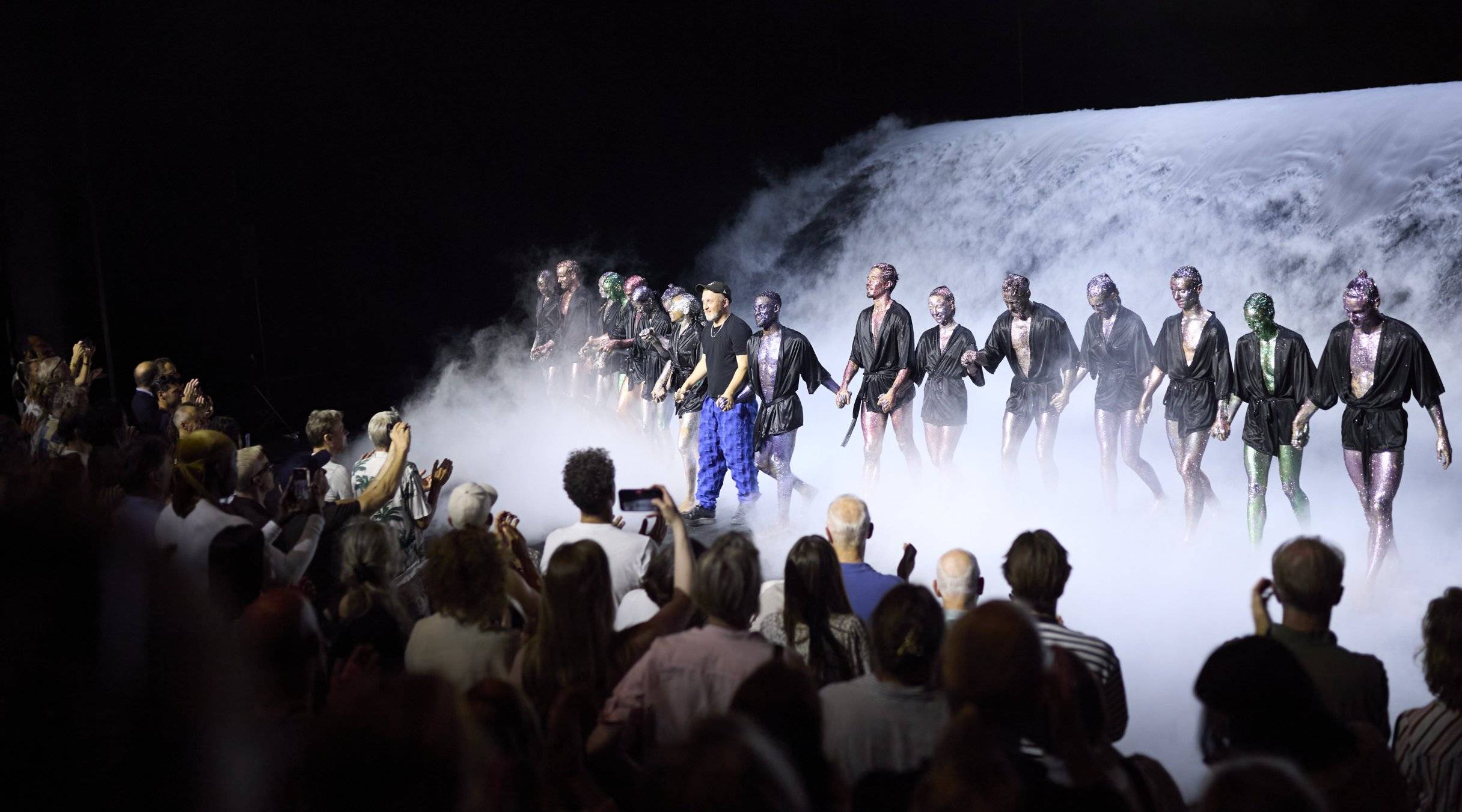
Bilderschlachten, by choreographer Stephanie Thiersch, and composer Brigitta Muntendorf also made a lasting impression with its extravagant costumes, choreography and score, weaving together references from across music history. Mirage, by Damien Jalet and Kohei Nawa, captivated audiences with a breathtaking performance that immersed them in the constantly shifting, undulating and sensual world of the dancers of Ballet du Grand Théâtre de Genève.
Alongside these large-scale productions, the festival offered intimate performances that encouraged audiences to empathise with others. In Sada (Echo) by Oz Oz, recently rediscovered tape recordings of letters from a man to his late wife formed a moving meditation on memory, loss and empathy. Juggle & Hide by Wichaya Artamat recounted Thailand's recent political history through hundreds of everyday objects – from toy soldiers to alarm clocks – playfully connecting the personal and the political. QAQNAS, the opera by Huba de Graaff and Naaz, based on a Kurdish poem about independent women, also explored this intersection, giving it a powerful musical expression.
Towards the 80th anniversary
In the lead-up to their 80th anniversaries in 2027, Holland Festival, Festival d'Avignon and Edinburgh International Festival co-produced a performance together for the first time, marking the beginning of a long-term collaboration between the three festivals.
This year's result was A Trial – after An Enemy of the People by Christiane Jatahy and Wagner Moura. In ITA, the fate of Moura's character was decided by a jury of eleven audience members. Jatahy and Moura relocated Ibsen's An Enemy of the People to present-day Brazil, exploring the influence of media, power and disinformation on society.
Investing in the future of the performing arts
Holland Festival is committed to contributing actively to the future of the performing arts. This year, the festival once again organised an extensive international professionals programme, including a programmers' weekend and an international festival exchange, providing opportunities for artists and presenters from the Netherlands and abroad to exchange knowledge and expand their networks.
The festival also offered a comprehensive education programme for secondary school pupils and students from a wide range of disciplines. Participants attended performances, explored different artistic forms and learned to write critically about the performing arts under the guidance of experienced reviewers.
This year also saw a renewed collaboration with DEGASTEN. Young creators aged 13 to 31 developed the performance JÖRĐ, inspired by the work of associate artist Hildur Guðnadóttir. Presented to an audience in the Small Hall of Muziekgebouw, the work explored the theme of "ground": is it soil, the body, memory?
Looking ahead to 2027, Holland Festival is preparing for a special anniversary edition: the 80th anniversary of the Netherlands' oldest international performing arts festival.
Facts and figures
With an average occupancy rate of over 80% and many sold-out performances, the 79th Holland Festival was a successful edition. The festival took place from 3 to 28 June 2026 in Amsterdam and Heerlen. Across 23 venues, audiences experienced 104 performances, including 14 co-productions, two Holland Festival productions and four world premieres. No fewer than 27 artists made their Holland Festival debut this year.
The unpredictability of the Dutch weather presented some challenges. While the opening performance City of Floating Sounds largely escaped the rain, the traditional Opera in the Park had to be brought to an early close after one hour due to approaching thunderstorms. By contrast, during the final days of the festival, audiences sought refuge from a record-breaking heatwave in the cool surroundings of the festival's theatres.
The 80th Holland Festival will take place from 3 to 27 June 2027.
Photo credit: Mirage © Marina Chef