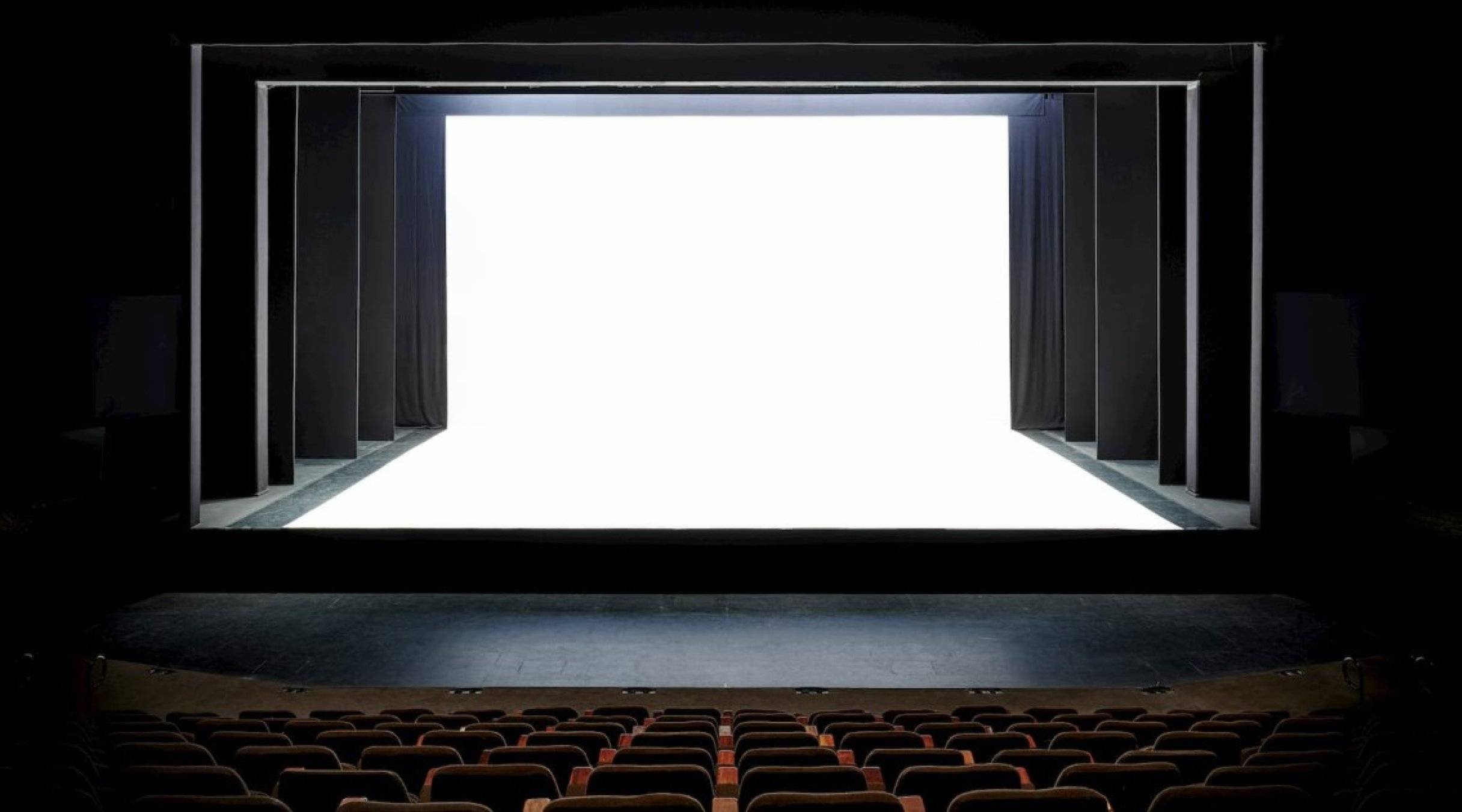
Quoting Germaine Kruip, A Possibility is a collection of her 25 years in art, in which her emphasis here is delivered through two media, sight and sound, justifying its setting at the Internationaal Theater Amsterdam (ITA), whose own positioning has already sparked conversation as a leading podium for “performances,” as the sophistication of Kruip’s piece demands a highly technical space such as ITA for its realization.
A key concept carried over from Kruip’s perceptual, experimental practice, of which are usually situated in museum spaces, is the perception of time. What stands out in A Possibility is perhaps not a historical, prolonged sense of time, but the temporality of the moment: how a single instant might be stretched to a length longer than itself.
It is in the pre-show announcement that an encouragement toward complete blackout, hinting at the significance of light in the performance, so significant that each audience member was provided with a small black pouch to store their phone and other light-emitting devices.
This is especially true during the first act, which unfolds as an extended experiment in light and darkness. Sitting in our seats in a mutual, almost subconsciously agreed-upon silence, the audience is quietly compelled to track the subtle shifts of light across the space, from near-darkness to brief brightness and back, until Kruip inserts a spatial illusion in which the three-dimensional stage flattens into a single surface, disorienting the audience through this dissonance. The slowness, while it allows for reflection on the spot, also builds a kind of lethargy and numbness.
One idea I want to offer here is how Kruip resolves at ease a long-standing struggle among artists and storytellers: the creation of a fantasized image. After a stretch of flashing, strobing black-and-white light, Kruip turns to shaping geometry – establishing a three-dimensional form, a rhombus suspended above the stage, constantly adjusting its illuminated face, emerging out of the two-dimensional condition she’d built in the previous light changes. It leaves the audience uncertain whether the shift in angle is real or imagined. By offering no tangible object, Kruip creates a dense yet subtle discomfort that many artists fail to achieve. Compare the failed attempts: Frankenstein’s creature, or the Demogorgon from Stranger Things, both relying on a visible, tangible body for emotional stimulation, and so collapse the very ambiguity Kruip manages to sustain.
Coming out of the total, frequent darkness of the first act – something I jokingly call what Amsterdammers might not have experienced in a while, now that summer has arrived – I was reminded of Notes from Underground, since the first act echoes the opening of Dostoevsky’s eponymous novel, itself a sustained monologue of introspection. The darkness offers few visual anchors to hold onto, leaving one, much like Dostoevsky’s Narrator in his underground room, to turn inward – not toward comfort, but toward the only vantage point left available.
While there’s a maturity to Kruip’s technical explorations, the use of theatrical space itself still feels underdeveloped by comparison. What lingers in retrospect is less the resonance of the piece on its own terms than its resonance against this theatrical setting and ITA’s technical proficiency. As introduced on ITA’s website, the performance consists of two acts. The question of how these “acts” tie to one another remains prominent, and somehow the thread between them never quite tightens. The first act ends, or second act begins, with a full lights-up, the inverse of a blackout: the previously whitened backdrop reveals its warehouse-like bare brick walls, with the performers walking on alongside Kruip’s custom-made instruments. It's impossible not to anticipate when the lighting will shift again – yet beyond their movements, almost no intention is legible to the eye: why this positioning, why black shirts and blue jeans – resolving into an abruptness and discontinuity that isn’t resolved until near the very end, when a flickering light cast back on the audience offers a callback.
A more intimate, or direct, question that follows might be: why do we sit? What does sitting do to the moment of sound perception, if not music perception? With the customized brass instruments crafted by the prestigious Thein Brass on stage, confining ourselves to our seats only distances us from it, leaving us unable to fully take in the rhythm and composition, if any is intended.
In seeing a work as such, I must surrender to how little an analytic lens can actually provide. Across every possible framing of meaning-making, the account is hard not to collapse, not because of the concepts themselves, but because of the specific register of Kruip’s artistic exploration, providing it being the “relationship” amongst sculpture, sound and perception. I remain skeptical of the possibility of “neutrality” in performance; still, in A Possibility, beyond flattening thought to a personal, experience-based level, I’d encourage a viewer to consider an alternative politics arising from this seeming dissolution.
Looking back, while the piece presents itself as a memoir, the viewer might also place themselves in the creative’s shoes (or lighting booth): is there a certain permissiveness built into performance art? Here, something beyond emotional resonance, beyond empathy or sympathy, becomes a responsibility. All the gap-filling and puzzle-solving fall almost entirely to the audience – making us something of an endangered species in performance today.
Bart Van den Eynde, dramaturg of A Possibility, closes the performance’s Kunstenfestivaldesarts evening pamphlet with an image of the audience as cameras capturing the performance’s moments – confirming an uneasy, vanishing sense of human perception, while also lending support to Kruip’s exploration of capturing time. Still, I remain doubtful of this framing: it casts perception as a mechanical, image-recording act, when Kruip’s experiment with time relies instead on an illusion-like shapeshifting rooted in the instability and fallibility of the eye, rather than in the cold precision of a camera lens.