In 2023, I visited the massive Mark Rothko retrospective at the Foundation Louis Vuitton in Paris. It was a dizzying experience; eleven different halls from the trajectory of a mesmerizing artist, from figures to colors and finally greys. Early in the audio guide, narrated by Christopher Rothko (Rothko’s son), a very specific piece of advice was offered: To truly experience Rothko's work, you must move step-by-step from the beginning to the very end. You must play with your physical distance, retreat far, press close, accumulate the artwork within yourself, and absorb everything until one painting finally speaks to you. He insisted that one would definitely speak, and that the moment would be impossible to miss. At first, this felt to me more like a romanticized myth. But as I wandered through the later halls, I spotted one painting when I entered a hall, which to an outside observer, might look like any other Rothko’s painting that comes to mind, but suddenly, it began speaking to me. It is difficult to articulate a rational description of what "speaking" meant in that moment, but the physical reality is tangible: I started crying. I pulled closer to the painting, completely in obedience, unable to take my eyes away, desperate to sit before it and dissect exactly how and why a surface of paint was enacting such a profound emotional coup on my nervous system.
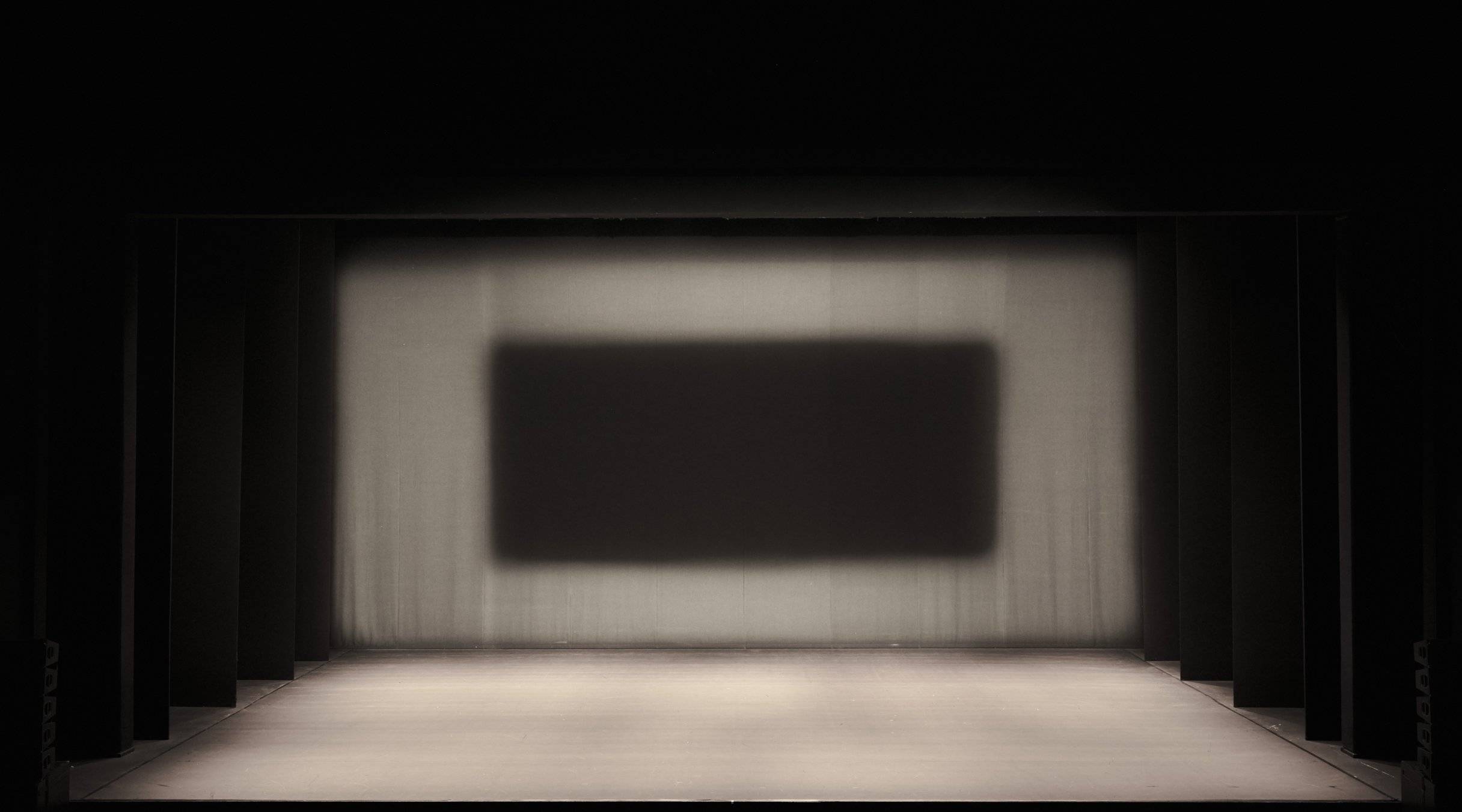
Sitting in the theatre for Germaine Kruip’s A Possibility, I was pulled back to that Rothko experience; simultaneously a twin and an opposite of that LV expo. In the experimental exploration of no actors, no narrative, and no drama, in a proscenium theatre, there was a skillful orchestration of light and darkness. And just like that late Rothko painting, Kruip's minimalist environment built a tension that eventually triggered an equally extreme, destabilizing bodily shock for me. Right after a violent brightness followed by a mysterious, blackness that was getting close to me, that I could not discover if it is a mist or my eyes’ perception, my heart rate spiked. I was struck by an intensity that made me wonder whether I could endure the space or if I needed to flee the theatre entirely. It was shocking that just light could strip away my orientation so completely that I could no longer tell if I was observing objective reality, if my eyes were accomplice with the author to play tricks on me, or whether the crowd around me was having the same visual hallucination.
As explained during a pre-talk by Bart Van Den Eynde, the dramaturge of the piece, Germaine Kruip originally graduated in theatre but left the medium for the visual art, finding theatre-making too restrictive. However, during a residency at EMPAC in New York, she was invited to bridge the visual art into the theatre; And she took the chance/change. As I understood, the performance I witnessed under the title A Possibility in June 2026 was a combination of the first two chapters of a planned trilogy dedicated to light, sound, and the senses. The composition is split almost down the middle: the first 40 minutes are dedicated to light, the sound is a complementary to the sight, the final 30 minutes shift weight to sound, in simple visibility of the stage.
In the light phase, Kruip makes the architecture of the theatre itself a living, breathing character. She avoids the traditional hierarchy of the stage as the focus, and the rest of the theatre in darkness, and she uses theatre’s own internal illumination including the house chandeliers to brightly expose hidden corners of the auditorium and show the space in its wholeness and beauty. In the empty space of the theatre, geometric shapes, squares, rectangles, and minimal music unfold meditatively in 40 minutes. Then, the performance executes a moment of nakedness and exposure: the backstage curtain rises, unadorned and barely seen structural bones and doors of the theatre become visible.
Following this exposure, human presence enters the space. Four percussionists of Asian ethnicity appear on stage (I am not comfortable to include ethnicity in this intended abstraction but it is just something not ignorable for me). They perform with geometric precision, drumming on bars suspended from the ceiling that move up and down along exact horizontal lines. Here the performance shifts from a visual study into an acoustic study.
When the work was premiered in 2016, it had the title A Possibility of an Abstraction. The core inquiry of the piece rests within this title: Is abstraction actually possible, or does the human mind with its compulsive, relentless need to construct associations, makes abstraction impossible?
My human mind refuses to remain abstract; If the conceptual intention was to purge the theatre of signifiers to achieve pure abstraction, the artistic choices work against it in the last 30 minutes: Casting four performers of Asian ethnicity, combined with the specific ritualistic rhythm of the drumming, introduces an unavoidable binary for me between Western geometric form (the squares, the circles, the light (of knowledge)) and Eastern spiritualism and ritualism in the second part. As an audience member, these ethnic and cultural markers carry an association when coming together, that cannot be ignored or meditated into abstraction anymore. My mind begins making meaning, weaving narratives of exoticism, ritual, and cultural juxtaposition, thereby proving that true abstraction cannot survive inside the theatre where everything on the stage is doomed to be a signifier.
During the pre-talk, the dramaturge noted that Kruip was heavily influenced by the cultural critique found in Byung-Chul Han’s book The Disappearance of Rituals. Han argues that modern neoliberal society, with its obsession with digital communication and production, has destroyed rituals that once anchored human community and stabilized our perception of time. In our media-saturated daily lives, we are trapped in a state of "serial perception" endlessly chasing new, being a shallow stimuli. With this context, Kruip’s work attempts to take the audience out of this digital hyper-activity, (one early explicit attempt: we are asked to put our phones in a little black bag during the show) into an attention mood of depth and purity, like a ritual. In the sound phase though, because of the special dictation of the theatre space, due to frontality that stays unchanged, the experience never gets close to a ritual. The show claims to be an exploration of feelings and an embrace of the body, rather than an intellectual exercise, but I would argue the opposite as A Possibility doesn’t acknowledge the audience's body because its physical delivery remains completely frontal, addressing the head more than the body. Our eyes are placed on the front of our heads; light is a frontal, objective phenomenon, therefore the first part works perfectly, we look forward, and we maintain an aesthetic distance from the image. Sound, however, is omnidirectional. Our ears sit on the sides of our head; our entire body absorbs vibrations. By forcing a ritualistic acoustic landscape to operate within the strict, frontal hierarchy of the traditional theatre stage, Kruip keeps the audience at an observational distance from the intended ritual. We are not participating, we are watching performers barely participating in from afar. Witnessing the sensory extremes of a ritual without our own bodies being permitted inside creates a source of anxiety, At some points, A Possibility feels less like an aesthetic meditation and more like a cruel assessment of the audience's physical tolerance. Such as: after being held in absolute, sensory-depriving darkness, the space suddenly explodes with a white flashlight screen, or elsewhere the drumming sounds go very high. These moments don’t turn into structural tension; it is a physical pain on the eyes and ears, but pathos without catharsis, violence without anchor or aim.
As I tried to elaborate, my encounter with A Possibility has a bittersweet aftertaste. It is an uncompromised experimental piece for proscenium theatre that absolutely demands to be experienced in person. Its architectural manipulations are untranslatable to video or digital documentation or any other medium. In my experience, the work achieves a brilliant half successful attempt at true abstraction with the light part, beautifully transforming the theatre space. Yet, the moment the sound and human presence enter, the abstraction fades away. The weight of cultural associations, the unearned physical violence of the sensory overstimulation, and the frontality of ritual keeps the experience on the surface.
Den Haag
15 June 2026