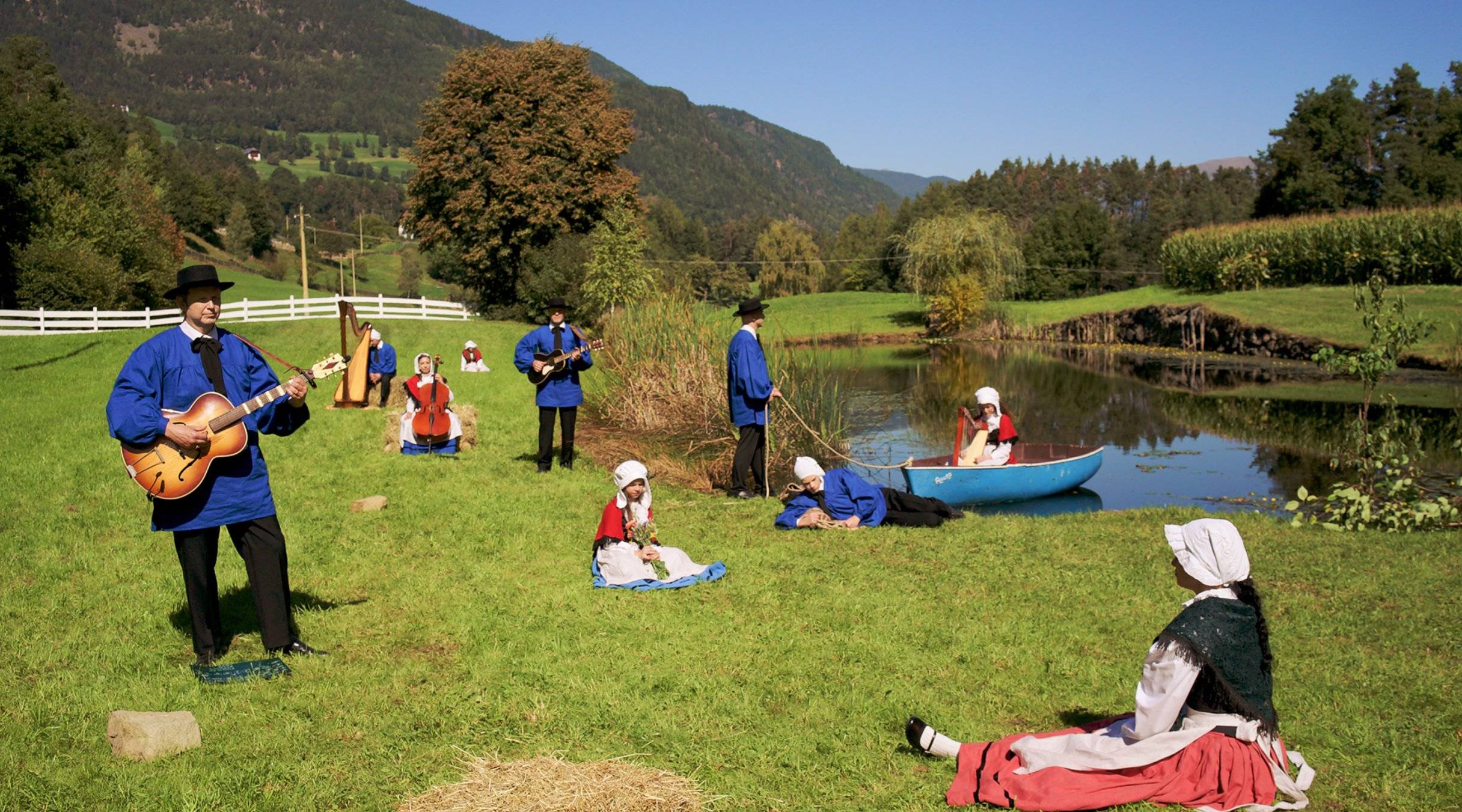
Your Eyes in My Head (2026) and Sunday Without Love (2025) is a double exhibition by Laurie Anderson and Ragnar Kjartansson respectively hosted at Molen van West as part of the Holland Festival. Laurie Anderson is an multidisciplinary artist and musician based in New York, working in an interdisciplinary mode that merges image, sound, text, and technology. She is considered to be a pioneer within the creative field. Your Eyes in My Head is predicated on the idea of entering inside of the artist’s mind, hearing her thoughts and wonderings, being taken on a journey through her memories, living her experiences alongside her. It is an ambitious and intricate project, aiming to immerse the listener into another’s subjective experience. Ragnar Kjartansson is an Icelandic artist. The informative text accompanying the piece tells the visitor that Sunday Without Love was inspired by a postcard he had on his fridge which showed people in folk costumes in a pastoral setting, but contradictingly one of them had a jazz guitar. Kjartansson is said to be both empathetic and sardonic towards feelings in his work, and an element of this ironic engagement with deep emotional experience can be seen in Sunday Without Love.
I experienced Your Eyes in My Head as rather alienating and at some points even unbearable. It was an interesting concept to create a purely audio piece. I enjoyed the novelty of going to an exhibition, which I usually associate with visual media, and being asked to simply sit and listen, immersing myself within a soundscape. The location itself is beautiful, and this certainly adds to the experience. The installation takes place in a long all glass room overlooking the canal on one side and the historic windmill on the other. Visitors sit in specially constructed wooden chairs, which are comfortable, staring out of the windows. This forms a pleasant visual backdrop for the piece, which is a 20 minute audio. However, for me this setting constituted the most enjoyable aspect of the piece. The first sounds you hear were jarring and unpleasant; a kind of grinding, industrial noise. This transitions into a commentary by the artist, presumably signifying her thoughts and recollections. It details a conversation with a Buddhist who suggested that the artist’s experiences talking to angels and beliefs in Buddhist teachings on reincarnation may be all in her head. Anderson describes this as being a deep challenge to her beliefs. In the piece, she says that she found the suggestion to be both incredibly awe-inspiring and lonely. I was unconvinced by this narrative, and was left with the impression that the piece might be more impactful if the listener themselves had deeply held spiritual inclinations of a similar kind. As I do not hold comparable religious beliefs, I could not relate personally to the premise. Perhaps Anderson highlighted this anecdote more out of the relevance to the piece’s concept - that of something being entirely in her head and the listener then being brought into her internal world - which is in itself certainly interesting to explore, but I was rather unmoved in practice. This sensation of being unconvinced by the spoken elements remained throughout, and I felt more that the artist was attempting to insist that their contents were profound rather than feeling that depth for myself, in the way one might expect to be impacted by a profound insight or in witnessing another go through a revelatory transformation.
This may have been alleviated had I enjoyed the sonic qualities of the piece more. There were some elements that impressed me. Particularly, in the moments in which I heard the sounds of a person running from my far left behind me to my far right, which was incredibly realistic, an effect achieved through binaural audio. The noise grew louder and softer and seemed to move through my headphones in a way that led me to actually look behind me, searching for the phantom runner. Additionally, some of the sounds were genuinely enjoyable, such as the sounds of typing and a vocalised musical element that made me want to dance along to it. Many of them, however, were unpleasant to listen to, and perhaps challenging the listener or discomforting them was the intended aim. Anderson’s choice in including unpleasant sounds in the creation of her internal soundscape may be her inviting the listener into the less enjoyable aspects of her inner world, as the experience of life or of our minds is not always an easy one. Unfortunately, this translated for me personally as just feeling that I was being forced to endure a bad sound. Granted, this does reflect the sensation of being alive sometimes, undergoing experiences we must grit our teeth in order to get through. Following a spoken element describing the artist urging herself not to get on the same train she had gotten on before, which I read as a metaphor for not repeating mistakes of the past, the piece played train noises. These noises were grating; the sound of metal squeaking on metal. Anderson could have chosen more easily digestible sounds to represent the train, but if the train was in fact the embodiment of bad habits perhaps it makes more sense that she represented it as a negative noise. Similarly memorable were the noises of a person eating and drinking, which also felt more disagreeable than they needed to be. Due to the discomfort created, this piece may appeal to visitors who are less sensitive to auditory stimulus.
In contrast, Sunday Without Love was sensorily soothing after listening to Your Eyes in My Head. The piece consists of a video staged to mimic a scenic postcard. The performers remain static, to the extent that from a distance it is easy to miss the subtle movements of their singing and playing. The video is placed at the end of a long, dark room, so this effect was the first to strike me when I entered; I initially questioned if it was simply a song played over a photograph. The imagery of the video is extremely beautiful. It is set in a European landscape, possibly southern Germany, and the performers wear old fashioned costumes that are not easily placed to a specific time or region, but which could be of the 16th or 17th century and are not incongruous within the landscape. They are carefully placed throughout a field so as to resemble the composition of a painting, standing, sitting or laying on the grass, with one woman on a little blue boat held near the bank of a pond. In the background we see a small mountain. The sky is a cloudless deep blue and the landscape a lush green. The informative text accompanying the piece states that the lyrics of the song - ‘you must learn to live without love’ - disrupts the ‘bucolic mood’ of the setting by introducing elements of tragedy, longing, and resignation. I would disagree. Beauty can be a highly contemplative force, especially that of landscapes, and in this way be in fact quite melancholic. The gentle sadness of the song adds to this sensation, in a way that I thought very much intertwined the visual and auditory elements to create a peaceful and touching experience. The piece was simple and lovely. I left feeling refreshed. Despite, or perhaps because of, its relatively less ambitious concept, Sunday Without Love succeeded in creating an experience that emotionally impacted the viewer.