Upon walking into the hall, each audience member was handed a program booklet that presented these questions to us:
What power does joy hold in the face of a collapsing world? How can joy become a form of resistance?
Before coming into the theatre, I knew only that this was a dance piece, and that is was about joy; and after having read these questions, I was curious to see the ways in which resistance and joy could be translated through dance.
The stage is scattered with bright orange ping-pong balls, which gently wobble with the air, and then suddenly move with more urgency with the use of a fan. This immediately creates a fun, silly feeling, as this unpredictability is something I would be happy to watch and watch and watch. The lighting is warm, the theatre is full. What power does joy hold in the face of a collapsing world? How can joy become a form of resistance?
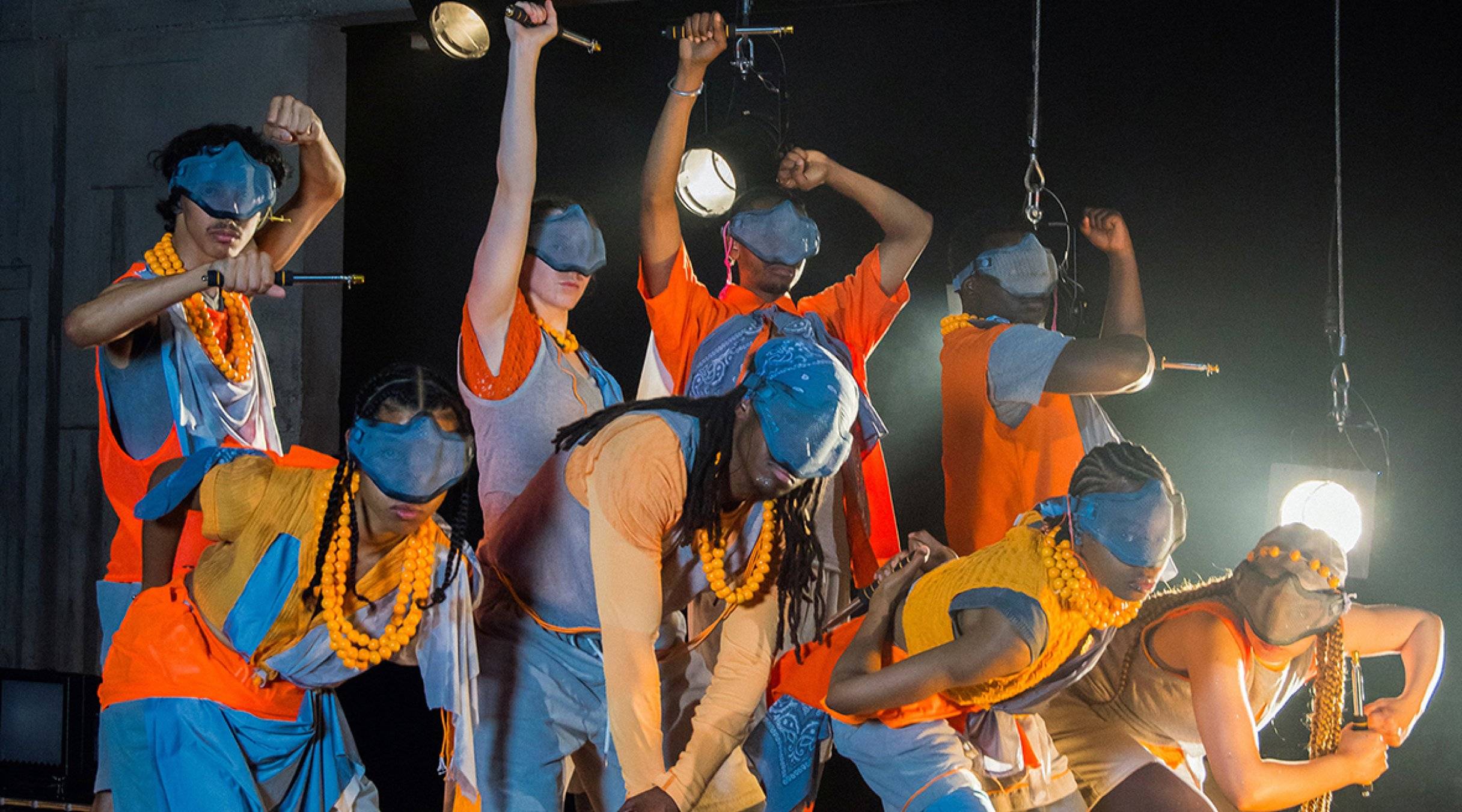
As the performers walk onto the stage, they are in a militarily straight line, facing us, mesh masks covering their eyes, and costumes of layers of orange and grey, suggesting they are here to construct and create. Although these use of colours and lighting creates the image of a line of construction workers, the non-uniform layers adds a disruptive dystopian look to the costume, immediately creating the feeling of future possibilities. The first movement they do is moving their heels legs in unison sharply from left to right with complete precision, before they move backwards and forwards in time with the music, but each in their own individual tempo. The ping pong balls that were a playful chaotic sight now create loud bangs as they are stamped on by the performers in their movements.
The piece carries on with segments of movements, flowing between unison between the performers and a disruption to that unison. This disruption was not just embedded in the choreography itself, but came through in the sound, lighting, music, and minimal props. Lights flickered, as if a fire had
been set, which quickly became the flashing lights of a club. Batons became a fencing rapier which ended up as an absurd elongated pole that the performers had to navigate. The music layered on itself, and shifted as the dancers did between phrases of dance. Between all of this, the occasional bang from a ping pong ball that had been trapped underfoot.
This piece navigated opposites, and asked questions beyond what joy can be. Where is the line between play and danger? What happens when we are together? What happens when we are apart? What is the connection between audience and performer? What do we expect to happen? What happens when it doesn't? As the audience, we are asked to consider the disruption that happens before us onstage, and find a way to look to the possibility that the future could hold, also inviting us into the weight of the memory that is embedded within the different dance styles that they used. The piece is cyclical: We end in the place where we began, but changed. The masks that the performers began with and had discarded are now back on, we are back in a line, but we have been on a journey of change with them.
The joy from the eight young performers themselves is palpable - they elegantly and effortlessly move with energy and lightness, fearless in their ability to pull the audience in, encouraging us to tackle the questions that the choreography invites. I can't help but feel joy watching them move. Even through moments that for me evoked feelings of fear or sadness, I felt as if we were encouraged to feel an optimism throughout the piece, affirming the idea that joy in times of political and social turbulence is, yes, a form of resistance. From the entrance of the performers, to the seemingly chaotic, yet minimal, setting, to the meshing of dance styles and tempos, along with the music that layered and shifted, there should have been a sense of unease throughout the piece, though this was not a feeling I experienced.
As we left, the last surviving ping pong balls continued to sway in the moving air, some landing at the end of the stage. As people filtered out, you could still hear the occasional pop of a person stamping on one of the balls, creating the feeling of joy, and disruption of joy, as an everlasting one, prompting us to take the questions beyond the theatre hall.