Before stepping into Laurie Anderson’s current sonic landscape at Holland Festival, I listen one more time to her 1981 masterpiece, O Superman, a track that every time excites me by its peculiar brilliance, its looping, electronic ha-ha-ha-ha, and its synthesis of the familial, the political, and the imaginary. O Superman is a work looking resolutely and curiously, as well as cynically, outward to the world. It conjures a mother that is simultaneously a country, a piece of land, and a military apparatus; It is a critique of power, technology, and the coldness of the mum’s automatic arms.
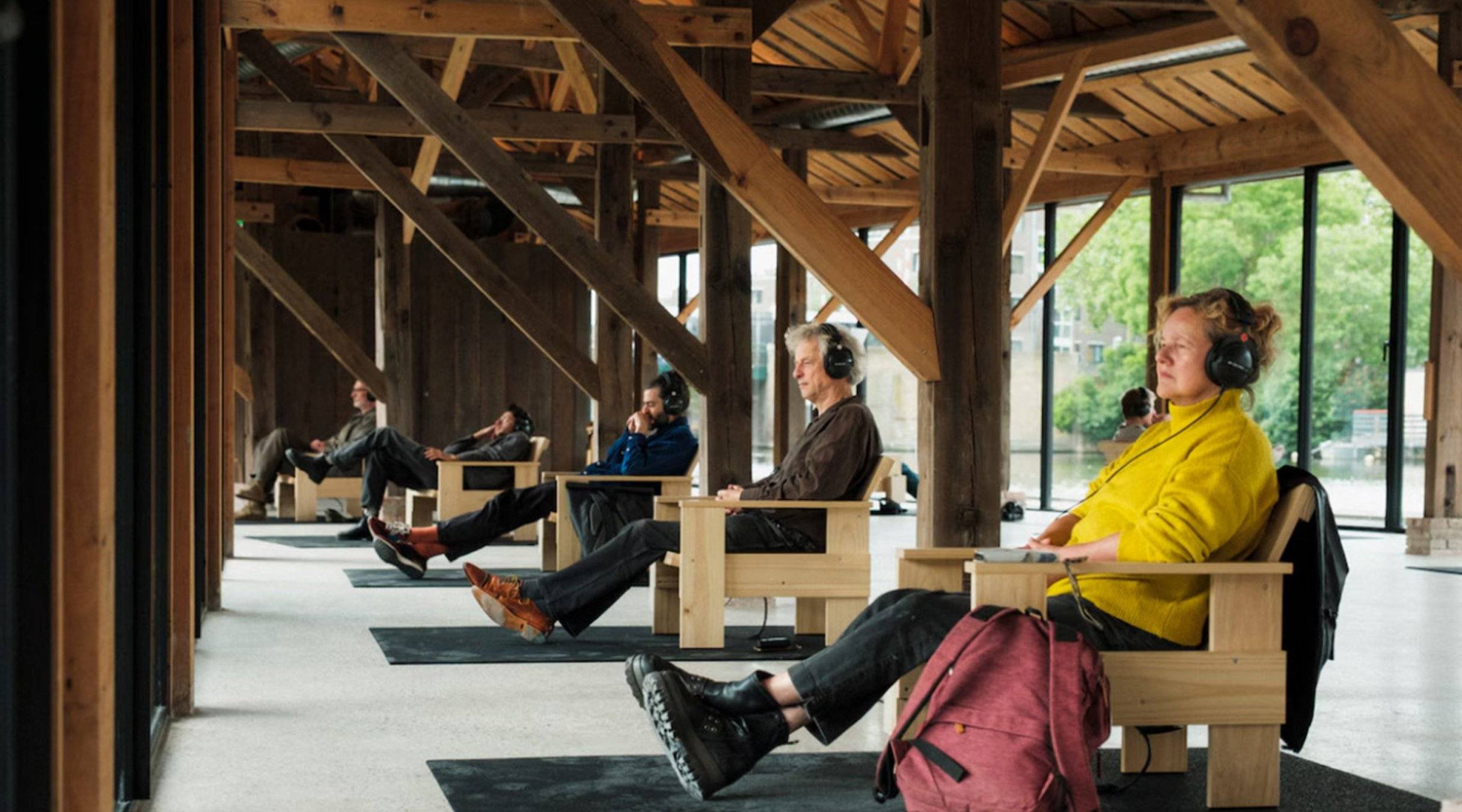
Decades later, Your Eyes in My Head is the next and first work of Anderson that I see in person. Situated in West of Amsterdam, in the Molen van West, the installation presents itself in simplicity. Upon entering the space, you are met with a curated environment of isolation and comfort: a set of high-quality headphones and comfortable chairs with enough space in between to avoid the next person, all facing outward of the glass walls of the space. You can choose between two viewpoints, each making a different relationship with the environment; you can sit facing the Windmill, however, because of its extreme proximity to the structure, almost nothing of the windmill is actually visible, or you can sit facing the canal side, looking out onto the water, a bridge bustling with pedestrians and bikers. Choosing the canal side, I put the headphones on, the immediate ambient sounds of the environment are erased, next to me sits a green button, activating the audio:
Here we go!
The initial auditory impression feels clinical or mechanical; Then the narration opens with an anecdote: six months ago, in India, the narrator was conversing with someone about reincarnation and the afterlife. When asked what happens when we die, and about coming in different shapes and characters, the companion replies: “This is all in your head.” Making the narrator burst into response the same sentence spoken out twice, once shocked and then frightened: How incredibly Lonely.
Your Eyes in My Head, stays on an opposition to O Superman; a profound departure or perhaps a necessary arrival. Where the earlier work wrestled with the external machinations of the world, this binaural audio marks a sharp cut toward a Buddhist-like search for redemption, inevitably shifting the gaze entirely inward. The outer world, as we all learn through crises, is cruel, real, and populated by bodies that are no longer there. The outward world offers no solace; Therefore turning away from the harsh external toward radically internal is a deliberate exile to the head where actually long gone things and people can exist. As we experience in this piece, through loneliness and grief, the narrator is left looking for remedies from foreign lands after Western pragmatism with its cold reliance on the zeros and ones, did not help to deal with emptiness and sorrow. Sadly but truly, where reincarnation is denied, when beautiful sound of Tibetan singing Bowl fails to wake us up to another awareness and just keeps dinging and dinging, names are the last hopes that might make appear after something that is gone.
"We die in three steps: first when our heart stops beating, second when our body is gone, and third, the very last time somebody says our name."
As we go on, the voice in the headphones manipulates space: running sound, getting closer, drifting far away, eating chips, internal thoughts, all tickling the imagination by layering sound over the live choreography of the canal and giving us the delusion of hearing from somebody else’s head; the sound engineering is masterful.
The stream of thought - “Don’t get on that train. Don’t get on that train.” – on the audio takes us on a personal yet collective grief; The displacement, the scars, and the ashes might belong to a single individual; but are indeed a collective burden for all humans, at different times and at a different pace. Looking for remedies to heal is another collective move that gets individual turns.
“Sometimes I feel like you can see from my eyes, and I feel that you are in my head because there are certain ways that I say things that are just the way that you would say them.”
Your Eyes in my head is a short exploration of loneliness without a promise of salvation. The rhythmic, repetitive, sometimes playful, and stinging sentences keep spinning and facing the failure. Yet, in failing to provide a magical cure for grief, the installation succeeds in capturing/conjure one closely in my head.
This installation is paired with another work at Holland Festival, called Sunday Without Love by Ragnar Kjartansson; unfortunately this pairing appears in my perception slightly untasteful. Sunday Without Love though playing beautifully with perspective, depth and music stays on the border of being installed in the dark space rather than being an installation with a relation to its environment and/or to its audience. Though being potential, the previous installation left me filled in my head(!) in a way that made me appreciate this second work less than in its own right, at the same time I believe the work could play with atmosphere or other elements to engage the audience more.
Den Haag,
11 June 2026